

Lauren Emily Wilson(Aka) Lauren Emily Wilson
281 Creekside Dr, Gray, GA 31032
 281 Creekside Dr, Gray, GA 31032
4783195309
 4783195309
My Bio
I'm a dedicated and compassionate School Counselor eager to provide students with a positive direction to achieve mental, social, emotional, and academic wellness. I am well knowledgeable in the ASCA Code of Ethics, responsibilities, and duties of a Georgia Certified School Counselor.
Resume & CV

Reflective Journal
Goals (Personal & Professional)
Competency Assessments
I've decided to use my Behavior Regulation Psycho-educational Small Group PowerPoint for the Counseling Prevention & Intervention section of my portfolio. This presentation explores preventative and interventional counseling practices, providing a select group of kids struggling with classroom behavior, solutions, methods, and suggestions on appropriate conduct strategies. We are collaborating with teachers and attempting to stop undesirable future behaviors by providing them with behavior skills in the small group. One of my responsibilities as a school counselor is to create initiatives, like behavior groups, that aim to stop disruptive and detrimental behavior. Working with educators, administrators, and parents to help these students learn to control and regulate their emotions and behaviors is another aspect of my job.
Part of the job of a School Counselor is collaborating between community partners, administrators, and teachers to help the positive growth of the school. I want to also create clubs to meet on unmet needs in the school. As a School Counselor, its my ethical and legal responsibility to understand and be accepting of different cultures, races, and lifestyles. Advocating for all students to be successful regardless of their race, culture, or gender is an important aspect of following the ASCA Code of Ethics and being a successful School Counselor as well. Expanding my own personal knowledge of different cultures, races, and religions are ways I plan on being an effective and culturally competent school counselor.
The artifact I choose for My Collaboration and Consultation portion of portfolio is the School Counselor Annual Calendar. This calendar gives examples and shows ways that a School Counselor collaborates with administrators, teachers, parents, and community partnerships in order to help all students succeed. As a School Counselor, one of my essential roles will be promoting, facilitating, and advocating for collaboration with students, administrators, teachers, parents, community partnerships, and College Admissions representatives to promote all students’ academic, career, and social/emotional development.
Through the process of my Practicum and Internship 1 course and fieldwork, I have followed the ASCA Code of Ethics that is required of me as a School Counselor. I've designed and implemented different counseling theories, techniques, intervention, and prevention strategies for each student in my school in regards to their specific needs. I'm a multicultural competent school counselor, by understanding and respecting that there are different races, religions, cultures, and lifestyles that are different from mine, and I always give need and consideration to all students and families. I can access and interpret all students' needs. I also apply relevant research to all school counseling theories and practices. I want to design programs, groups, and lessons that enhance students' academic, social, and emotional development. I work with students, parents, and families to address problems that can affect student's academic success in school.
Courses Taken
Projects
Internships
Prompt #1: – In your own words, summarize how serving in both elementary and secondary schools has contributed to your understanding of the diverse developmental needs of K-12 students, including exceptionalities? What have you learned about how K-12 students differ in their development and approaches to learning? How have you created opportunities that are adapted to diverse learners?
Serving in both an elementary school and a secondary school has contributed to my understanding of the different level of maturity of student, the social, emotional, and academic needs of a student as well. My elementary school supervisor and I worked a lot on zones of regulation, impulse and behavior control with students. My secondary supervisor and I worked more with the mental health aspect of a student. Some students had anxiety and/or depression in my secondary placement, but a lot of students that I worked with in my secondary placements self-harmed, had thoughts and/or plans of killing themselves. As a school counselor, I have learned that a lot of students come from different socio-economic backgrounds, I work with different races, religions, and different cultures then those of mine, and I need to take into account everyone and how others learn and interact. By catering my counseling strategies to be diverse and inclusive, students will comfortable opening up and talking to me.
Prompt #2: – The Association for Spiritual, Ethical, and Religious Values in Counseling (ASERVIC) states, “The professional counselor recognizes that the client’s beliefs (or absences of beliefs) about spirituality and/or religion are central to his or her worldview and can influence psychosocial functioning.” How have your field experiences contributed to your understanding of the importance of including K-12 students’ religious and spiritual supports, especially if religion and spirituality are valued by the K-12 student?
As a school counselor, it is important to understand that not all students, come from the socio-economic background, race, religion, or culture as the school counselor. It is my job to help them learn, explore, and understand their own background, culture, or religion to the best of my ability. By being a certified school counselor, it is also my job to not let my personal opinions or get in the way of helping and counseling students that come from different socio-economic backgrounds, races, religions, or cultures then those of my own.
Prompt #3 – How have your field experiences contributed to your understanding of the importance of including the K-12 student's family, community, and culture as a source of support?
The field experiences have contributed to my understanding of each student by helping students explore, learn, and understand more about their personal family, community, and culture. Asking questions, helping students learn and research more their family, community, and culture, and also giving them resources to help deepen their own knowledge are ways that I have supported students during my field experiences.
Prompt #4 – How has your field experience strengthened your professional identity as a school counselor? What aspects of the school counselor's role, scope of practice, and the referral process have you learned from collaboration and consultation?
My field experience has strengthened my own professional identity by learning the process of what the day in the life of a school counselor looks like. I learned what different roles each of my site supervisors played in each school. Each day in my Practicum and my internships looked so different. The school counselor at both of my sites collaborated with administration, parents, the community partnership that the county had in place such as mental health agencies, food banks, and outreach programs that assisted families in need. The school counselor also showed me the steps to making an DCFS (Department of Children and Family Services) report, when there was suspected abuse going on in the child’s household. When I start my job as school counselor, I will be familiar with the collaboration and also the school counselor’s role in the school.
Exam History
Licenses & Certifications
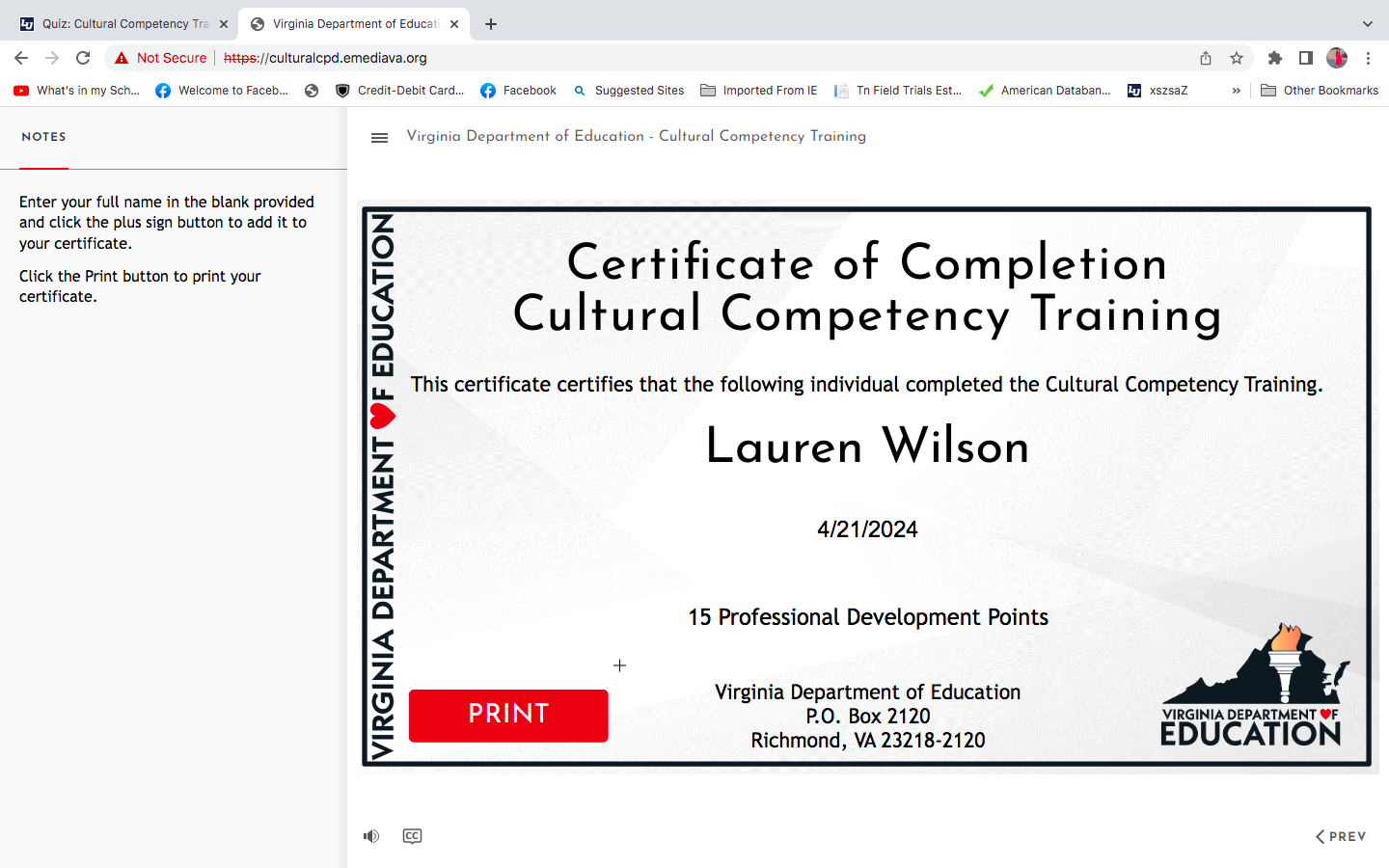
Cultural Competency Training Certificate
View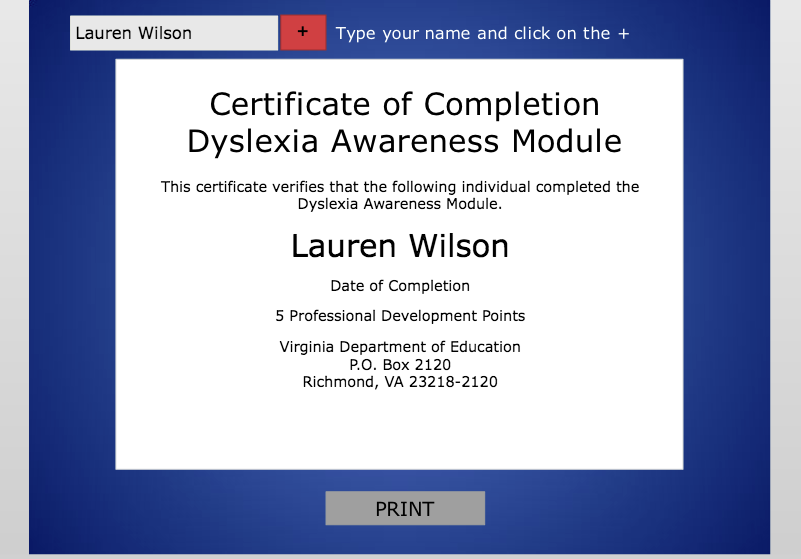
Dyslexia Awareness Training Certificate
View